
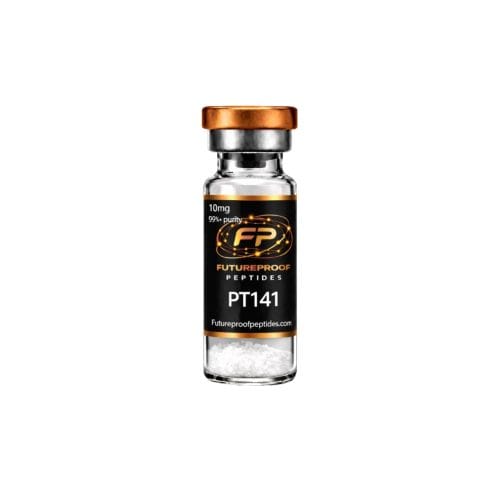
PT 141 10MG VIAL
£24.99
Free Shipping Over £50 (UK)
- Free Worldwide Shipping Over £100
- Fast Delivery
- Secure Payments
- Satisfaction Guaranteed
RESEARCH PURPOSES ONLY:
Overview of PT-141 (Bremelanotide) 10mg
PT-141 10mg, chemically known as Bremelanotide, is a synthetic research peptide frequently utilized in scientific studies due to its interaction with the melanocortin receptor system. While many compounds in reproductive physiology focus on vascular pathways, PT-141 is distinguished by its primary activity within the central nervous system. This specific mechanism makes it a key subject in neuroendocrine research, behavioral neuroscience, and receptor pharmacology, where scientists observe how melanocortin receptor activation modulates neurological pathways related to motivation and behavior.
Please note: This product is supplied strictly for laboratory research, analytical testing, and in vitro investigation. It is not intended for human or veterinary administration.
What is PT-141?
Developed as a synthetic analogue of earlier melanocortin compounds, Bremelanotide was initially noted by researchers for its distinct pharmacological profile, which diverged from peptides designed for skin pigmentation. Instead, its effects pointed toward receptor activity in the brain.
PT-141 functions as a melanocortin receptor agonist, targeting specific receptors—primarily MC3R and MC4R—located within the hypothalamus and surrounding areas of the central nervous system. Because these receptors regulate crucial physiological signaling pathways, PT-141 remains a prominent tool in endocrinology, neuropharmacology, and behavioral neuroscience.
Research Motivation for PT-141
Unlike compounds that mainly target vascular function, PT-141 is studied for its unique interaction with neuronal signaling networks. This distinct pathway enables scientists to analyze how receptor stimulation drives behavioral changes without depending on direct blood vessel dilation.
Unlike compounds that mainly target vascular function, PT-141 is studied for its unique interaction with neuronal signaling networks. This distinct pathway enables scientists to analyze how receptor stimulation drives behavioral changes without depending on direct blood vessel dilation.
Ongoing laboratory studies investigate how the activation of melanocortin receptors can advance knowledge in:
- Neurological Signaling: Central nervous system pharmacology, peptide receptor biology, and hypothalamic signaling.
- Reproductive & Hormonal Health: Reproductive physiology, neuroendocrine communication, sexual dysfunction, and desire disorders.
- Behavioral Dynamics: Behavioral motivation models.
These experimental trials aim to deepen the scientific understanding of how neurological pathways respond to receptor-mediated stimulation.
Mechanism of Action
Scientific literature indicates that PT-141 functions by activating specific melanocortin receptors within complex neural networks. Instead of triggering a direct circulatory reaction, this receptor binding is thought to modulate communication across various brain regions responsible for regulating behavior.
Scientific literature indicates that PT-141 functions by activating specific melanocortin receptors within complex neural networks. Instead of triggering a direct circulatory reaction, this receptor binding is thought to modulate communication across various brain regions responsible for regulating behavior.
This distinct process has drawn significant attention from the scientific community, as it offers an entirely different methodology compared to traditional compounds focused on cardiovascular pathways. Under strict laboratory settings, investigators continue to evaluate how this neural mechanism connects to sexual function, behavioral habits, and brain communication.
Primary Fields of Scientific Inquiry
Contemporary studies into PT-141 span across multiple biological disciplines. Active research areas include:
Contemporary studies into PT-141 span across multiple biological disciplines. Active research areas include:
- Neuroscience & Communication: Behavioral neuroscience, central nervous system signaling, and neuropeptide receptor interactions.
- Pharmacology & Signaling: Melanocortin receptor pharmacology, comparative peptide analysis, and hypothalamic peptide networks.
- Physiological Models: Experimental reproductive physiology and motivational behavior frameworks.
Scientists also remain focused on observing how these pathways adapt over time during controlled experimental setups
RESEARCH PURPOSES ONLY

Reviews
There are no reviews yet.